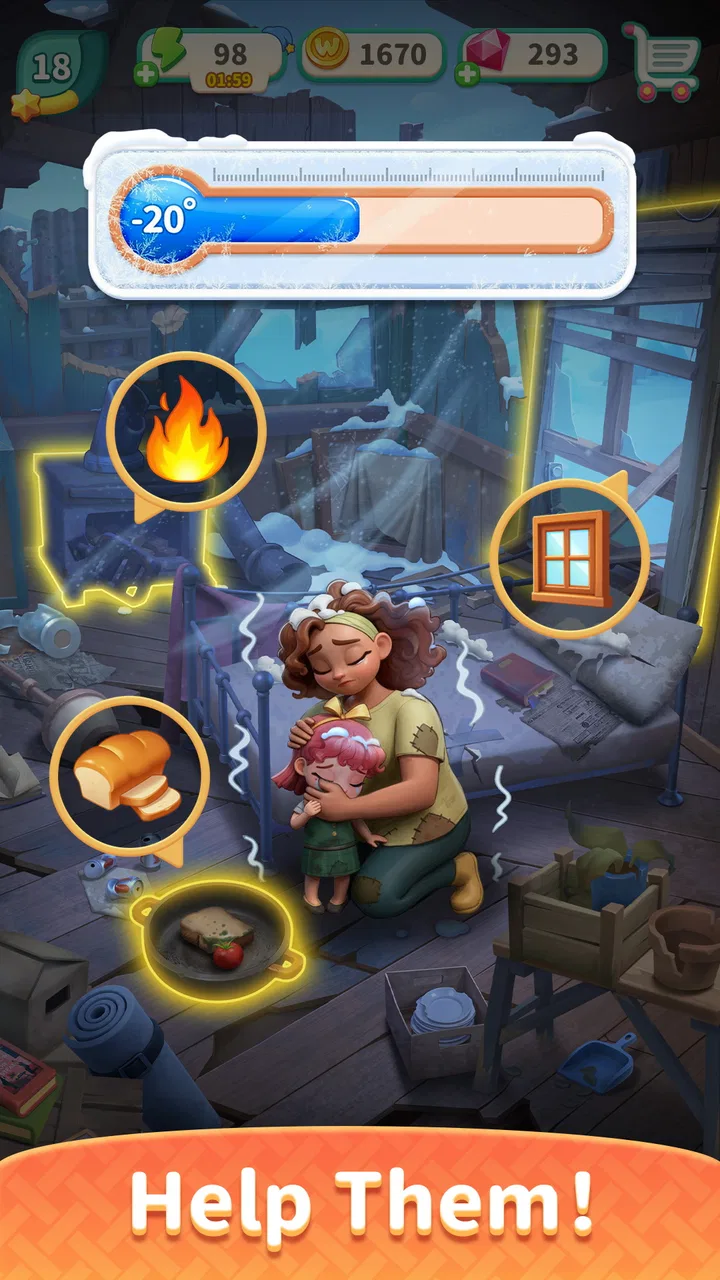
Merge World: Drama & Story
- 3.7
- Rating
- 100.00K
- Installs
- Free
- Price

 Analysis by App-foxy
I went into Merge World: Drama & Story expecting a light casual game, but its appeal is less about quick tapping and more about deciding when a merge is actually worth making. The basic idea is easy to understand: combine matching pieces, clear space, and use the result to move the story forward. What makes the experience more interesting is the tension between immediate progress and saving useful items for a better chain later.
That balance gives the game a pleasant “one more move” quality. I can play for a short break without needing a long tutorial, yet the board still asks me to think ahead once several objects compete for limited room. It is free to start, and the Teen content rating makes it more suitable for older players than a purely child-focused puzzle. At the same time, the drama framing means this is not simply a silent matching board; the story presentation is part of the reason to continue.
How the current version feels to play
MaxDrama presents the game as a casual merge experience, and that description fits the moment-to-moment rhythm. I can open it, make a few combinations, and put it down without losing the whole evening. The strongest sessions are the ones where I begin with a small goal, such as clearing a crowded area or creating a higher-level item, rather than merging everything as soon as it appears.
You May Also Like

 AccuWeather: Weather Radar
AccuWeather Review: A Quick, Clear Forecast for Everyday Decisions
For everyday plans, the best forecast is the one you can understand quickly. AccuWeather makes rain timing, radar, and local conditions easy to act on, with a few trade-offs.

 Hill Climb Racing
Why Hill Climb Racing Still Turns Crashes Into One More Run
A tiny car, a bumpy hill and one more upgrade: Hill Climb Racing keeps resurfacing because its simple chaos makes every near-miss feel personal.

 AliExpress - Shopping App
AliExpress Makes Global Shopping Feel Personal, but Shoppers Bear the Risk
AliExpress turns a global marketplace into a pocket-sized discovery engine. Its reach is useful, its shopping loop compelling, and its trade-offs easy to miss.

 Lords Mobile: Kingdom Wars
Lords Mobile Is a Kingdom-Building Routine, Not a Quick Match
A case-by-case verdict on the building, battles, device demands, and social commitments that make Lords Mobile rewarding for some players and exhausting for others.

 PDF Scanner app - TapScanner
TapScanner Makes Paperwork Easier to Capture, Check, and Share
TapScanner makes scanning with a phone feel less like a rescue operation and more like a dependable step in getting work done. Its capture tools are useful, though not flawless.

 Block Blast!
 Shows How Much a Puzzle Game Can Leave Out
A quiet grid game shows why puzzle players increasingly value instant clarity, repeatable skill and low-pressure play—and where the genre still needs to catch up.
More From Our News Desk
View All News


The central decision is simple but important: do I combine two available pieces now, or keep them separate because one may be useful for another objective? That choice creates more depth than the short store description suggests. A careless merge can leave awkward gaps or remove the exact pair I wanted for a later move. I found that pausing for a moment before every combination makes the board feel more manageable.
The story angle also changes how I judge progress. In a conventional merge title, the satisfaction may come almost entirely from building a larger object. Here, I am also looking for the next narrative beat. That can make routine board work feel purposeful, especially when I want a game with a little more context than an endless sequence of disconnected puzzles.
Still, I would not describe it as a pure story game. The merging remains the main activity, so anyone downloading it primarily for deep character writing or a large interactive plot may find the balance different from what they expected. I see the narrative as motivation around the puzzle loop, not a replacement for it.
The first sessions and the learning curve
The opening experience is approachable because the action is familiar: identify matching pieces and combine them. The challenge does not come from learning complicated controls. It comes from understanding how much board space matters and resisting the impulse to make every obvious merge immediately.
My most useful early habit was to scan the entire board before touching anything. I look for pairs that can unlock space, then check whether a nearby item could become part of a longer sequence. This small pause prevents the common mistake of filling the board with isolated leftovers. It also makes the game feel less random, because I am choosing a route instead of reacting to the first available match.
Another practical tip is to treat empty spaces as a resource. An open square is not wasted room; it is flexibility for the next few moves. If I spend all available space on low-value combinations, the board becomes harder to read. When I preserve a small working area, I have more options when new pieces arrive.
This is where the title suits players who enjoy relaxed planning. It is not demanding in the same way as a fast action game, but it can still punish messy organization. Players who prefer instant rewards may find the waiting and arranging less satisfying, while people who enjoy tidying a complicated board will probably understand the attraction quickly.
What version 115 means for regular players
The current version is 115, which tells me the game is being maintained beyond its earliest release stage. It launched on June 28, 2025, so the version number suggests an active period of iteration rather than a title left untouched after launch. That is useful context for anyone deciding whether to begin now: the experience is not being presented as a one-off experiment, but I would still judge it by what is playable today rather than by promises about where it might go.
For an existing player, a newer version can matter in less visible ways than a dramatic new feature. Changes may affect stability, pacing, interface behavior, or the feel of progression. I would recommend updating before making a serious judgment about the game, particularly if an older installation feels rough or inconsistent. The important point is that version 115 is the current reference point for the experience, while future improvements remain expectations rather than something I can treat as guaranteed.
The release timing also affects how I interpret the community response. The game has an average rating of 3.7 from around 881 ratings, with 148 written reviews. That is a mixed but meaningful signal: enough people have tried it to reveal differing reactions, yet the score does not support calling it universally polished. I read that as a reason to approach with realistic expectations, especially if smooth progression and highly refined presentation are essential to me.
Its reach is already visible through more than 100K installs. That does not automatically make it the best merge game, but it does indicate that the concept has found an audience. I would still separate popularity from personal fit. A player who likes story-led casual puzzles may enjoy it more than someone who wants a purely strategic board with no narrative interruptions.
How it fits into an ordinary day
A realistic use case is a short waiting period: I have ten minutes before an appointment, open the game, complete a few merges, and stop after reaching a natural point. The format works well there because I do not need to remember a complicated control scheme. When I return later, the board itself gives me a visual reminder of what I was trying to build.
It can also work as a wind-down game, but I would be careful with that recommendation. The casual pace is calming when the board is under control. Once the available space becomes crowded, however, I may spend more attention than intended trying to repair a poor sequence of merges. For me, it is better as a deliberate short break than as something I open automatically whenever I am tired.
The game is less suitable for a shared family tablet used by very young children because its content rating is Teen. That rating is an important practical detail, not just a label to ignore. I would choose a child-focused puzzle for a younger player, while an older teen or adult who enjoys light drama and organizing puzzles is more likely to find the tone appropriate.
Where the free model changes the decision
The game is free to download and play, but it includes in-app purchases ranging from $0.99 to $99.99 per item. That wide range is worth considering before I become invested in the progression. Free entry is convenient, yet the presence of optional spending can change how comfortable the game feels during longer sessions.
My advice is to decide on a personal spending boundary before buying anything. In a merge game, a small purchase can feel tempting when I am close to a goal or when the board is inconveniently full. Setting a limit in advance helps me judge the puzzle on its own terms instead of treating every obstacle as a reason to spend.
This model is not automatically a flaw. Free access lets curious players test the core loop without committing money first. The trade-off is that players who dislike any pressure around purchases may prefer a paid casual game with a simpler cost structure. If I want a completely predictable expense, a one-time purchase elsewhere may be the better fit even if that alternative has less story flavor.
I also would not assume that spending makes the game more enjoyable. The most satisfying part for me is planning a clean sequence and seeing the board improve through my own choices. Paying may reduce friction, but it can also remove some of the decision-making that gives the merge loop its character. I would only consider a purchase if it solves a genuine annoyance rather than because I feel rushed.
Three habits that make the board easier to manage
First, I separate “space-making” merges from “progress” merges. A combination that clears a troublesome corner can be more valuable than one that produces a visibly larger item. This is a non-obvious shift in priorities: the best move is sometimes the one that improves the board rather than the one that looks most impressive.
Second, I avoid building around a single desired chain too early. If I reserve too much room for one plan, the rest of the board can become unusable. I prefer a flexible layout with a small number of open positions, because it lets me adapt when the next pieces do not match my expectation. This approach is especially helpful during short sessions when I want steady progress without restarting my mental plan.
Third, I stop after a successful cleanup instead of continuing automatically. Ending on a tidy board gives me a better starting point later and prevents a good run from turning into a cramped one. It is a simple workflow, but it makes the game feel more controlled and reduces the urge to make low-quality merges just to keep moving.
These habits do not require special knowledge or purchases. They come from treating the board as a limited workspace. That is the main strategic lesson I took from the game: matching objects is only half the task; arranging future choices matters just as much.
Comparison with familiar merge alternatives
Compared with a basic merge puzzle that focuses only on combining items, this game has a stronger reason to care about what happens next. The drama and story framing give progress a destination, which can help when the board work starts to feel repetitive. If I want a little narrative motivation alongside casual planning, this is more appealing than a completely abstract alternative.
On the other hand, players who prefer pure optimization may find the story layer less useful. A minimalist merge game can be easier to understand because every element serves the board. Here, the presentation asks me to divide attention between the puzzle and the surrounding progression. That is not a problem for me, but it is a genuine trade-off.
It also differs from fast arcade games. There is no need for rapid reactions in the way I would expect from a reflex-focused title. The pressure comes from limited room, imperfect choices, and the temptation to continue. If I am looking for immediate action, this will feel slow. If I want a calmer game that still gives me small decisions, the pace is a strength.
Against premium casual games, the free model is the clearest distinction. I can try the concept without paying upfront, but the in-app purchase range means I need more self-control around optional spending. A paid alternative may offer a cleaner relationship with progression, while this one offers easier access and a story-led reason to keep returning.
Who should try it, and who should skip it
I would recommend it to players who enjoy arranging objects, planning several moves ahead, and having a light narrative reason to continue. It is particularly suited to short sessions where I want something more engaging than a passive distraction but less demanding than a competitive game.
I would also suggest it to people who like discovering their own routines. The game rewards scanning, preserving space, and choosing when to stop. Those details are easy to overlook, but they make a noticeable difference once the board becomes busy.
I would skip it if I dislike merge mechanics at their foundation. The story does not remove the repeated cycle of combining and organizing. I would also look elsewhere if I want a fully premium experience with no purchase prompts, a fast action game, or a deeply complex strategy system. This title sits between those extremes: accessible, lightly strategic, and built around casual progression.
Device compatibility is reasonably broad because the minimum operating system is Android 7.1. That makes it approachable for people who are not using the newest phone, although the practical experience can still vary with hardware and system condition. I would install it on a device with enough free space to keep the board and interface comfortable, rather than treating it as something to squeeze into an already overloaded phone.
What I would watch as the game develops
The most important future question is whether updates continue to improve the balance between board management and story progression. A good merge game needs enough variety to keep decisions meaningful without making the player feel blocked. I would pay attention to whether later play remains flexible or increasingly encourages spending to overcome friction.
I would also watch how MaxDrama responds to the mixed rating. A 3.7 average suggests that the game already works for many players but leaves room for refinement. The useful signs would be smoother everyday play, clearer progression, and fewer moments where the board feels difficult for reasons unrelated to strategy. Those are the areas that most affect whether a casual game becomes a regular habit.
For current users, the practical approach is simple: keep the game updated, learn to protect open space, and avoid spending impulsively during a frustrating board. For new players, I would give the free version a fair trial during several short sessions rather than deciding after a single rushed attempt. The game’s strengths become clearer once I stop treating every move as an automatic match.
My overall view is positive but measured. Merge World: Drama & Story succeeds when I want a relaxed merge board with a narrative push, and its current version shows that the project is still being actively shaped. Its weaknesses are equally clear: the gameplay remains repetitive by design, the mixed rating warns against expecting perfect polish, and the optional purchases require attention.
In the end, I would recommend it to a friend who enjoys casual puzzles and likes having a story around the activity. I would describe it as a game to sample thoughtfully rather than blindly commit to. If the combination of tidy planning, gradual progress, and light drama sounds appealing, the free entry makes trying it reasonable. If I want pure strategy, no monetization concerns, or fast action, I would choose a different kind of game instead.
FAQs for Merge World: Drama & Story
01What is Merge World: Drama & Story about?
Merge World: Drama & Story is a casual narrative game that combines item-merging puzzles with an unfolding drama. You complete merge chains to create useful objects, restore or decorate locations, and progress through story scenes. Characters, relationships, and plot developments provide the main motivation, while the puzzle system offers short tasks suitable for relaxed, occasional play.
02How does the merging gameplay work?
The core gameplay involves combining matching objects to produce upgraded items. You usually begin with basic materials and merge them repeatedly until you create something required for a task or renovation objective. Energy, timers, limited board space, and event items may affect your progress, so organizing the board and choosing which chains to prioritize is important, especially during longer sessions.
03Is Merge World: Drama & Story free to download and play?
The game can generally be downloaded and started without an upfront purchase, but it may include optional in-app purchases. These can provide extra energy, speed up timers, unlock resources, or offer special bundles. Progress is possible without spending money, although free players may need to wait for energy regeneration or accept slower advancement during demanding chapters and limited-time events.
04Does the game require an internet connection?
An internet connection may be needed for several important functions, including loading story content, synchronizing progress, displaying advertisements, processing purchases, and participating in events. Some basic interactions might work temporarily offline, but this should not be assumed for the complete experience. Connecting before playing also helps reduce the risk of progress not syncing correctly.
05Is Merge World: Drama & Story suitable for children?
The merge mechanics are simple and generally easy to learn, but the game is built around drama, relationships, and story conflicts that may not appeal to every child. Advertising, optional purchases, and possible online features should also be considered. Parents should review the current age rating, privacy information, and device purchase controls before allowing younger players to download it.
Pros
- Relaxing merge gameplay that is easy to learn and play casually.
- Story-driven chapters give the puzzles a stronger sense of purpose.
- Short tasks work well for quick sessions during breaks.
- Frequent item combinations keep the board feeling active and rewarding.
- Colorful visuals and character scenes make the game inviting.
Cons
- Energy limits can interrupt play when you become invested in a chapter.
- Some upgrades and story progress may require considerable grinding.
- The game can feel repetitive after many similar merge objectives.
- Ads or optional purchases may be needed to speed up progress.
- Limited board space can make item management frustrating at times.

Merge World: Drama & Story
Gallery